
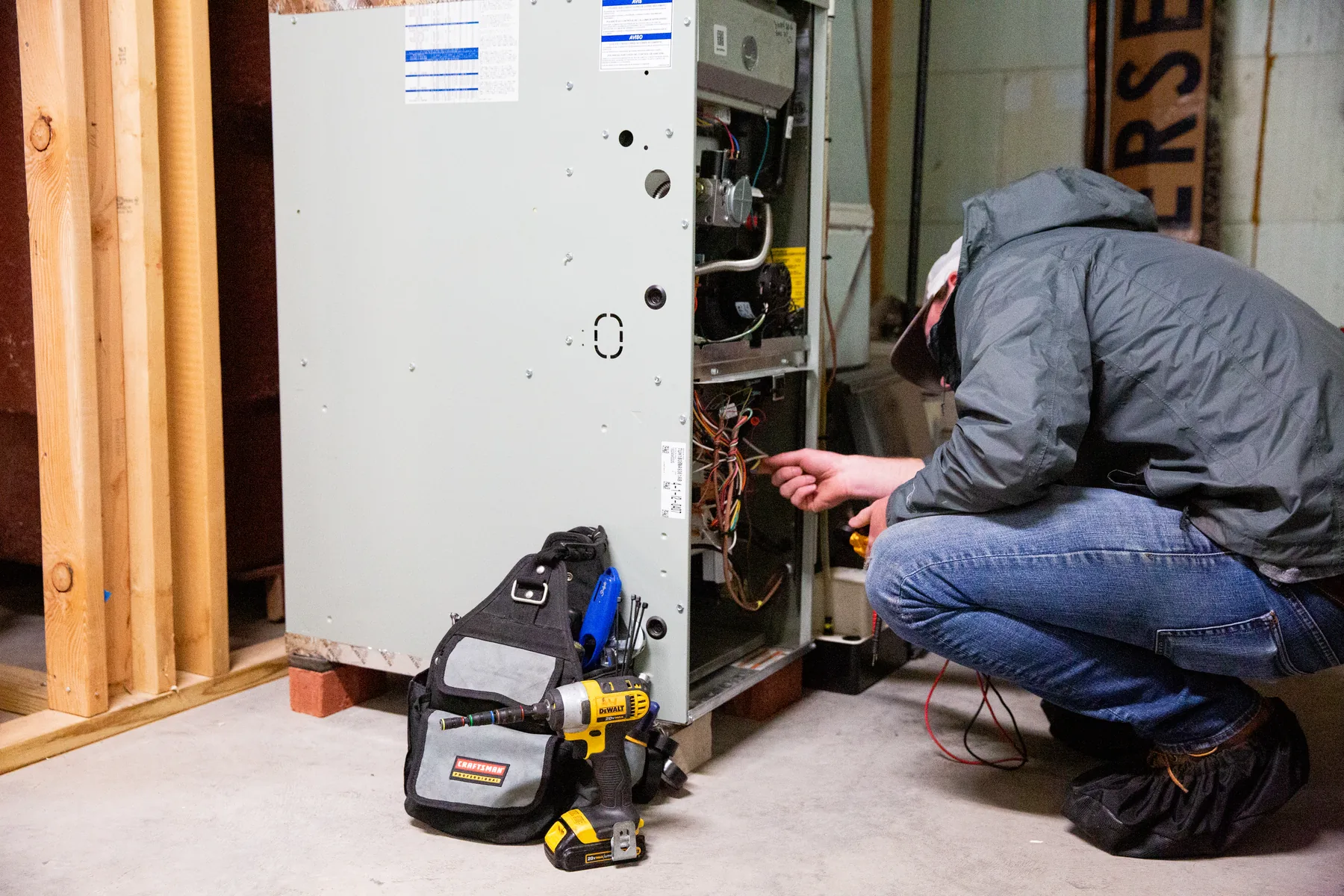
January nights in Paris average 26.6°F, according to NOAA’s 1991-2020 climate normals, and the first hard freeze is when most furnace problems show up. Usually it’s a system that ran fine last winter and then sat for eight months. This guide covers the failures that are most common, what furnace repairs typically cost, how to decide between repair and replacement, and the warning signs that mean you should shut the furnace off and call right away. If your furnace is producing no heat at all, start with the seven checks you can safely run yourself, because a fair number of no-heat calls end at the thermostat or the filter.
What’s Wrong With Your Furnace? Four Common Failures
Most furnace problems fall into four groups: ignition and flame sensor faults, airflow restrictions that cause short cycling, blower and inducer motor wear, and gradual efficiency loss from dirty burners or aging parts. Knowing which one you’re looking at tells you how urgent it is. A furnace that runs but blows cool air is usually a small, inexpensive fix. A furnace that booms when it lights, or keeps shutting itself off with a clean filter, should be looked at promptly because both involve combustion or overheating. The sections below walk through what each symptom usually means, so you can describe it clearly when you call.
The Furnace Runs but the House Never Warms Up
When the blower moves air but the air isn’t warm, the usual causes are the igniter, the gas valve, or a dirty flame sensor. The flame sensor is a thin metal rod that confirms the burners actually lit. Once it’s coated with residue it can’t detect the flame, so the furnace shuts the gas off as a safety measure, tries again, and quits again. Cleaning or replacing a flame sensor is one of the least expensive furnace repairs.
It Starts, Runs Briefly, Then Shuts Off Again
Short cycling usually points to overheating, and overheating usually points to airflow. A clogged filter, closed registers, or a failing blower motor all restrict the air moving across the heat exchanger, so the furnace trips its high-limit switch and shuts down to protect itself. Replace the filter first. If it keeps happening with a clean filter, turn the furnace off and call, since repeated overheating is hard on the heat exchanger.
You’re Hearing Something New
A boom or delayed “whoomp” when the burners light means gas is building up before ignition, and it needs a technician soon. Grinding or squealing usually comes from the blower motor or its bearings. Rattling is often a loose panel or a worn draft inducer motor.
Your Gas Bill Jumped but Your Habits Didn’t
A furnace that’s losing efficiency burns more fuel for the same heat. Dirty burners, a weak inducer motor, leaky ductwork, and an aging heat exchanger can all show up on the bill before they cause a breakdown. If your usage held steady and the bill didn’t, have the system checked.
What Does Furnace Repair Cost in Paris, TN?
Most furnace repairs cost between about $100 and $1,100, depending on which part failed, based on Trane’s published national averages. A flame sensor or igniter sits at the low end. Inducer motors, gas valves and blower motors land in the middle. A heat exchanger replacement can reach $3,000. Trane also notes that a service call fee typically runs $50 to $200 and that some companies apply it toward the repair if you hire them for the work, so ask about that when you call. The age of the furnace, whether the part is still stocked for your model, and whether the failure damaged anything else all move the final number. Get a written estimate before any parts go in.
These are national estimates from Trane, not Culley’s prices. Call us for a quote on your system.
| Furnace Repair | Typical Cost | Source |
|---|---|---|
| Flame sensor | $80 – $240 | Trane |
| Igniter | $100 – $250 | Trane |
| Thermostat | $100 – $600 | Trane |
| Pressure switch | $150 – $350 | Trane |
| Control board | $300 – $650 | Trane |
| Gas valve | $200 – $800 | Trane |
| Blower motor | $300 – $900 | Trane |
| Draft inducer motor | $400 – $1,100 | Trane |
| Heat exchanger | $1,000 – $3,000 | Trane |
Source: Trane, “Average Furnace Repair Cost”, updated February 2026.
If you’re on Culley’s VIP Maintenance Plan, repairs come with a discount of up to 25% and never a premium charge.
Should You Repair or Replace Your Furnace?
Repair the furnace if it’s under about 12 years old and this is its first real failure. Start pricing a replacement if it’s past 15 years, it needs a second significant repair in a few winters, or the heat exchanger has failed. Trane puts the typical life of a gas furnace at 15 to 20 years, depending on the equipment, the installation, and how well it’s been maintained. A common rule of thumb is the “$5,000 rule”: multiply the repair estimate by the furnace’s age in years, and if the result is over $5,000, replacement is usually the better use of your money. A $400 repair on a 10-year-old furnace comes to $4,000, so you’d fix it. The same repair on a 16-year-old furnace comes to $6,400, which is worth a replacement quote.
| Factor | Leans Repair | Leans Replace |
|---|---|---|
| Age of the furnace | Under 12 years | 15+ years |
| Repair history | First real failure | Second or third in a few winters |
| Which part failed | Igniter, flame sensor, thermostat, capacitor | Heat exchanger on an older furnace |
| Comfort in the house | Heats evenly when it runs | Rooms stay uneven even after service |
A cracked heat exchanger is the one repair to treat differently. It’s the part that keeps combustion gases separate from the air you breathe, so a furnace with a cracked heat exchanger shouldn’t run. On a newer furnace, the heat exchanger can often be replaced, and the part may still be under the manufacturer’s warranty. On an older furnace, replacing the whole unit is usually the better value.
If replacement is the answer, our guide to furnace replacement in Paris covers cost, efficiency choices and what to expect. Culley offers 0% financing with approved credit through Wells Fargo, so the cost doesn’t have to land all at once.
When Should You Turn the Furnace Off and Call Right Away?
Turn the furnace off and call immediately if your carbon monoxide alarm sounds, you smell gas, or people in the house feel sick in a way that improves when they leave. Gas and oil furnaces produce carbon monoxide as they burn fuel. A furnace that’s working and vented properly sends all of it outside, but a cracked heat exchanger or a blocked vent can let it into the house. According to the CDC, more than 400 Americans die each year from unintentional carbon monoxide poisoning not linked to fires, more than 100,000 visit an emergency department, and more than 14,000 are hospitalized. CO has no smell or color, so an alarm is often the only warning you get.
Shut the system down, get everyone outside, and call from a safe place if you notice any of these:
- Your carbon monoxide alarm sounds, even briefly
- You smell gas or a rotten-egg odor near the furnace
- Headaches, dizziness, nausea, or confusion that ease when people leave the house and return when they come back
- Soot, scorch marks, or rust streaks around the furnace or its vent pipe
- A burner flame that’s yellow or orange and flickering instead of steady blue
The CDC describes carbon monoxide symptoms as “flu-like,” which is why they’re easy to dismiss in winter. The pattern is the clue: if everyone feels better away from the house, have the furnace checked before running it again.
The CDC also recommends a battery-operated or battery-backup CO detector near every sleeping area, replaced per the manufacturer’s instructions or every five years, and a yearly service by a qualified technician for any gas or oil appliance. (CDC, “Carbon Monoxide Poisoning Basics”)
How Do You Prevent the Next Furnace Breakdown?
A yearly tune-up before the first cold snap is the simplest way to avoid a mid-winter repair. Burners get dirty, flame sensors build up residue, and blower wheels collect debris, and none of it is obvious until the furnace is running hard in January. A technician can catch those while they’re still cleaning jobs instead of part replacements. Changing the filter on schedule does a lot of the rest, since airflow problems cause much of the overheating and short cycling covered above.
Culley’s VIP Maintenance Plan includes two maintenance and safety inspections a year, an up-to-56-point tune-up, priority service, and up to 25% off repairs. It’s $189 for a single system and $99 for each additional system. If your furnace already needs attention, see our heating repair service in Henry County.
Frequently Asked Questions
Do HVAC companies fix furnaces?
Yes. Furnaces are part of HVAC, and Culley Mechanical Services repairs furnaces and heat pumps throughout Paris and Henry County. On most homes the furnace and air conditioner share the same blower and ductwork, so one HVAC company can service the whole system.
How long does a gas furnace last?
Trane puts the typical life of a gas furnace at 15 to 20 years, depending on the quality of the equipment, the installation, and how well it’s been maintained. Age alone isn’t a reason to replace a furnace that heats well. Once a furnace is past 15 years and needs a second significant repair, pricing a replacement is worth the time.
Can I run my furnace if the carbon monoxide alarm went off?
No. Turn the furnace off at the thermostat and the power switch, get everyone out of the house, and call from outside. Don’t restart the furnace to see whether the alarm sounds again. Have a qualified technician inspect it before it runs again. Culley answers emergency calls in Paris 24 hours a day at (731) 407-7799.
Get Your Heat Back On
Culley Mechanical Services answers furnace calls in Paris and across Henry County 24 hours a day, 365 days a year. Our technicians are factory-trained and NATE certified, we’re a Carrier Factory Authorized dealer, and your satisfaction is 100% guaranteed.
Here’s what one customer wrote in a Google review after a furnace repair in February 2026:
“They sent someone out right away to look at my furnace which had stopped working. The technician got right to work and figured out what was wrong, then said what it would most likely cost to repair. He had my furnace fixed sooner than expected.” (John M.)
Call (731) 407-7799. We serve Paris, Henry County, and nearby communities including Camden, Huntingdon, McKenzie, and Milan.
Related posts
 Air Conditioning
Emergency AC Repair in Paris, TN: 24/7 Same-Day Service
 Air Conditioning

